Why NAMs need better tools
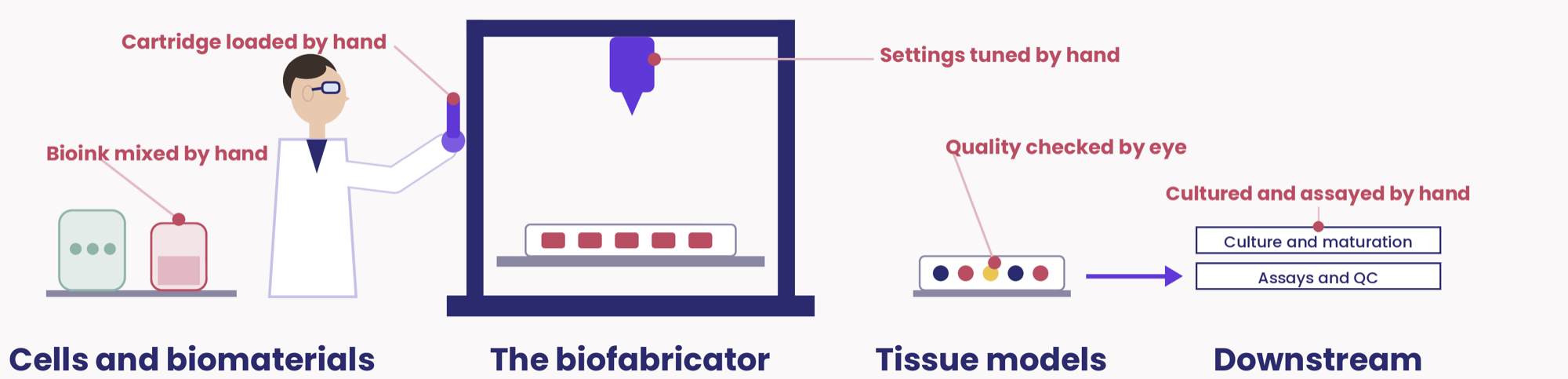
Regulators are moving away from animal testing, and human tissue models are one of the ways forward. Most of them are still made by hand, so few can be made the same way twice.
The demand is already here
New policy has arrived nearly every year since 2019. Bioprinted models already count as nonclinical tests under the FDA Modernization Act 2.0. In 2026 FDA issued draft guidance on validating new approach methodologies and began replacing animal testing terms with nonclinical ones across its drug regulations.
| 2019 | EPA plan to end mammal testing by 2035 |
| 2021 | EU Parliament resolution to phase out animal testing |
| 2022 | FDA Modernization Act 2.0 |
| 2025 | FDA roadmap to reducing animal testing · NIH prioritizes non-animal methods · ISTAND made permanent |
| Mar 2026 | FDA draft guidance on using new approach methodologies in drug development |
| Sep 2026 | FDA rule replaces animal testing terms with nonclinical across its drug regulations |
of the 27 tools in FDA's ISTAND pathway are biofabricated tissues
The pathway is open and bioprinting isn't in it
Once FDA qualifies a tool through ISTAND, any company can use it in any drug program for that purpose. The furthest along today is an organ-chip, and a central question in its review is whether independent labs reproduce its results.
No bioprinted tissue has been submitted. A model that changes from batch to batch can't answer that question.
FDA DDT qualification metrics and project database, 2026 · 91 Fed. Reg. 59,988 (2026) · FDA NAM draft guidance (2026)
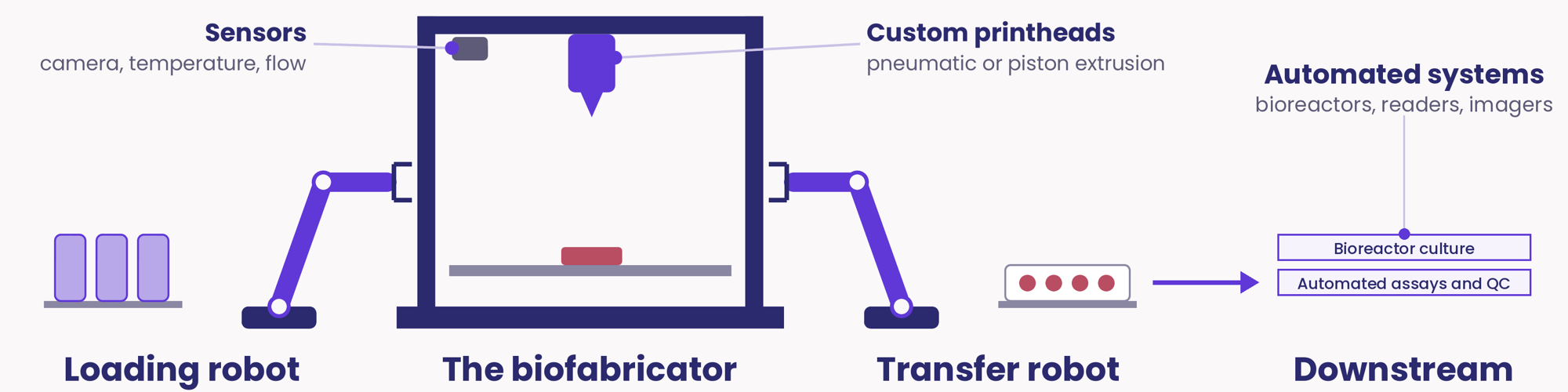
Biofabricators can automate 3D cell culture manufacturing
To get there we have to reduce the variance.
Drug discovery has been here before
After the 1962 Kefauver-Harris Amendment raised the evidence bar, the industry reorganized around structured and reproducible data. High-throughput screening was built on that foundation of standardized compound libraries and consistent records.
Tissue models need the same foundation, and it has to be simple enough for any lab to use.
We are building an automated line for tissue